Saturday, April 9, 2011
Potato Pancakes
Not only am I not Irish, I'm not Jewish either. Several weeks ago I went and scrounged a potato pancake that Cynthia and the girls made, and I remembered that I love these things. While I was cooking them, I also remembered that the last time I grated a potato must have been about 12 years ago. Probably about this time of year, while I was prepping the holiday latkes at that deli. (Yes, I know, Passover isn't the latke holiday, that's Chanukah, but it billed itself as a jewish deli, and...you know) I'm sure that's the reason why, in all this time, I have never made latkes again. I worked with a woman who was truly, horribly, injured making latkes. I don't know how many hundreds of pounds of potatoes I had to peel or how may dozens of times I shaved little pieces of my knuckles off with that demonic peeler. Thank goodness for the Robotcoupe. We had a mixing bowl as large as a kiddie pool that we mixed the grated potatoes for the holiday latke recipe in. Sometimes I wish I had one of those industrial food processors. I digress. Please note, that I did not bother to peel my potatoes today.
about a pound and a half of yukon gold potatoes, the newer the better
about 4 tablespoons of flour
about a teaspoon of salt
3 eggs
2 or 3 green onions
2 tablespoons, more or less, minced parsley
some pepper
olive oil for frying
This makes about 8, 4-5" pancakes.
Mince the green onion and parsley, and mix them with the eggs, flour, salt and pepper. Wash the potatoes and grate them into another bowl. Grab handfuls of the grated potatoes and wring out as much water as possible before adding them to the egg mix. You may be tempted to skip this part- don't. Once you get the potatoes mixed in with the salt in the batter, they will sweat out an amazing quantity of water.
Use 2 frying pans. Put about 1/4 inch of oil in each one and heat to medium. When the oil starts to shimmer in the pans, drop about 1/3 cup of batter for each latke into the pans. I can fit 3 latkes into a 10-inch pan. Cook them for about 5 minutes on each side, until they are golden and a bit crispy. Drain on paper towels.
Notes:
1. The potatoes will oxidize very fast. Grate quickly and mix them into the batter just as soon as you want to eat them. At the deli, we used to mix up a water bath with a few tablespoons of an anti-oxidant to grate the potatoes into. The anti-oxidant was this weird substance which demonstrated a property that I learned about in high school which I think is called 'heat of solvation'. That is, when a chemical in crystaline form is dissolved in water, it will release heat, due to the fact that an organized solid is a higher energy state than a bunch of loose molecules floating around in suspension. Some crystals will release quite a lot of energy this way. If you held a scoop of that anti-oxidant and dribbled a little water on it, you could give yourself a significant burn. (That's not what happened to Ann.)
2. As I said, the potatoes emit a great deal of water. You can either squish it out before frying, as I did, to keep your pancakes neat in appearance, or if you like an eggier latke, stir it back in. The last few will be rather sloppy, but will taste good.
3. Medium heat is best. They take longer to brown, but you need to cook them long enough to get the potatoes soft. Crunchy-raw potatoes are not very satisfying to eat.
4. Don't crowd the pans. Too many latkes all at once will generate a cloud of steam which will inhibit crisping. Cooked through is good, soggy is not.
5. You don't have to use yukon gold potatoes, any kind will do just fine. I like that variety because the color is appealing, and because the skins are usually thin and tender enough to dispense with peeling.
I did not have either sour cream or apple sauce, which is ok, because I don't like apple sauce unless I make it myself. Greek yogurt and raspberry jam was very good, and a fried egg is even better.
Friday, April 1, 2011
Hamantaschen
Sick of the cabbage yet? Yeah, me too. Have a cookie.
Cookies with stuff in them usually look too fiddly for me to bother with. I think that after my xiao long bao experiment, my idea of what constitutes 'fiddly' underwent a change. I read this recipe in the paper and thought it looked remarkably simple. The photos in the paper looked really good too, maybe I hadn't brought enough snacks with me to work that day. So here they are.
2 sticks (1 cup) butter
1, 8-oz brick cream cheese
6 tablespoons sugar
1 teaspoon vanilla
2 1/2 cups AP flour
1/2 teaspoon salt- you will want this if you use unsalted butter. I don't.
later you will need about 2 cups of jam and an egg for egg wash
I got 46, 2" cookies out of this.
Soften the cheese & butter to room temperature, then beat them together until they are well combined. Beat in the sugar and vanilla. You can use a spatula for this part. Then switch to your trusty pastry tool, and cut in the flour. As soon as all the flour is taken up, scrape down the bowl one last time and put the dough in tupperware to chill overnight. The next day, roll out the dough until it's between 1/4 and 1/8 inch thick. I have no cookie cutters, but the lip of a red wine glass is just the right size.
Each cookie will need about 1/2 teaspoon of jam. Fold up the cookies and put them on sheets in the freezer. Preheat the oven to 350. Once the cookies are frozen hard, you can put an egg wash on their outsides and sprinkle them with a bit of sugar. I did this on my second tray, and it does make them look much nicer. Bake them for about 30 minutes.
Notes!
2. But it is important that when you add the flour, you don't over-work the dough. That's why I strongly recommend the pastry cutter- it will quickly incorporate the flour without causing the gluten in it to sieze up and get rubbery.
3. A pastry cloth helps a lot.
4. Try to cut the circles as efficiently as possible, because while you can squash the leftover dough together and roll it again, each time you do that you will loose some of the tenderness in the finished cookie. 2 squashings and re-rollings is the maximum I would recommend.
5. Also, chilling the dough is indispensable. The first time because it is too gooey to manage otherwise, the second time because freezing will allow the cookies to retain their shape in the oven.
6. The original recipe says to paint a little egg wash around the edge of each dough circle before folding them up. I didn't do that, and as a consequence, some of my cookies unfolded while baking. If you are picky, or if your jam is a rather moist variety, I would say that you should take the trouble to do the egg wash. I'm lazy, and my jam was very sticky, so I decided to live with some amorphous cookies.
7. I made my own jam. It's just about 2/3 of a bag of prunes simmered until they're falling apart and then bashed up with a spoon. This sounds less appealing than it really is, but I did it because a) it allowed me to control exactly how much sugar, moisture, and texture was in the jam, b) plum filling is traditional, c) I like the caramelized bits that you end up with. They're chewy.
These are very, VERY hard to stop eating. The cookie part is really just an amazingly good pie crust, and if I want to make any sweet pies in the future, I'll have to think about using this recipe. It is tender, yet holds its shape, it puffs ever so slightly as it cooks, and it has a hint of flakiness. These are phenomenal while they are hot out of the oven, but once they cool, the cream cheese flavor in the crust comes back out, and the jam filling gets extra chewy.
I had to give 3/4 of the recipe to my siblings immediately. Even so, I caught myself thinking "So you ate 6 cookies earlier. That's not much different than say, a PBJ, right? And there are 6 cookies left. I could have those for dessert. That's like, one slice of pie...
Tuesday, March 29, 2011
Chinese chopped salad
This is comfort food of another kidney. Chopped napa cabbage in vinaigrette is the base for numerous variations of this salad, which can have any number of other things in it. Shredded meat bits are traditional, cold noodles often go in it, I think if you have a good pig's foot jelly, you can put that in it, or some thousand-year-old eggs. It's pretty open to interpretation, but I've departed from its traditional presentation and usage, although there are some good reasons for that.
4 or 5 leaves of napa cabbage, julienned
a few carrot matchsticks, for color
about 3 cauliflower florets, cut up into rather small bits
most of 1 scallion, green and white parts minced fine
a teaspoon grated ginger
2 tablespoons rice wine or cider vinegar
2 tablespoons light soysauce (dark is too salty)
1/2 teaspoon sugar
a teaspoon of sesame paste OR a teaspoon of peanut butter and a good dash of sesame oil
Mix the liquid ingredients thoroughly to make a vinaigrette, then toss in the veggies. You only need to let it marinate for about 2 minutes, napa is fairly soft t begin with. I like to shake everything up in tupperware container, but that's because I don't actually serve anything in real dishes. I just take pictures that make it look like I do.
Cauliflower is in no sense traditional, but what I was thinking is that since both napa and cauliflower are part of the same family of plants, they should taste pretty good together. I was right. Besides that, the cauliflower adds a visual and textural element which is otherwise lacking. I don't remember this salad ever having carrots in it when I was a kid, but hey, they were in the crisper drawer.
This part sounds a little funny: Serve the salad over hot potstickers. Yep, it is a good idea. The vinaigrette is basically just dipping sauce, right, and unless you're eating some awfully middling potstickers, there shouldn't be any big lumps in them, so the salad adds crunch. You could have the salad as a perfectly normal side dish, but somehow I enjoyed having everything piled up together. Maybe it was just me having a moment like I used to when I was little- you know, where you fling everything together and make a mess like you know you aren't supposed to, only this time hey, it turned out fine after all!
Monday, March 21, 2011
Shandong Irishman
I suspect that colcannon is to Irish people what meatloaf is to Americans- everybody has their own recipe which is indisputably the only correct version. I'm not Irish. I mean, so not Irish that I'm sort of convinced that even the white parts of me aren't Irish- they're Scots, as far as I know. Be that as it may, I wasn't kidding about the napa cabbage, that thing is haunting me.
The first time I encountered colcannon was at a party at Tom Harari's parent's house. I couldn't have been as much as 12 years old, because I remember all the adults being way taller than me. I don't remember what the party was in aid of, but it probably was not St. Patrick's day. Some lady brought colcannon. I thought, "Awesome! Mashed potatoes!" because, like Jej, I have a thing for mashed potatoes. I was really disappointed. The dish was cold. It didn't have any salt in it. The chopped vegetables in it were stiff, and undercooked, and cut up into large, unwieldy lumps. The parsley in it had sand stuck in its leaves. I kept hearing other people say "Did you try the colcannon? Try the colcannon, its great. You should try it." I started to think the name sounded really stupid. I have to assume this was one of those instances of kids having an adverse reaction to things which don't bother grown-ups- either that or the place was just full of feckless hippies who couldn't cook and didn't know any better.
The experience gave me a prejudice against colcannon for about 25 years. I don't know what happened after that, but one day I found myself thinking "Hmmm. Cabbage. Hmmm. Potatoes. Sounds good!" Now I make it several times every winter. This is the only time I've made it with a napa cabbage, though. Somehow, it didn't leap to mind, you know? But, since St. Pat's was just the other day, it seemed natural. This really doesn't come out any different from the traditional versions, because once they are cooked, napa and regular cabbage taste quite similar. Napa is a bit less stinky, and has a slightly more delicate texture, and so requires less cooking than ordinary cabbage.
about 3/4 lb potatoes. I like baby yellow ones.
about 1/4 of a medium sized napa cabbage
1 medium onion
2 tablespoons butter
salt to taste
2 or 3 tablespoons minced parsley. I like the curly kind, the bouncy texture is nice.
a little pepper
Chop the potatoes coarsely. I don't like to peel things, which is why I get baby potatoes. The skins are more appealing to eat. Dice the onion and put them and the potatoes in a heavy pot with just enough water to cover them. Bring them to a medium boil, and keep them there until the water has almost all evaporated. Add the butter and the napa leaves, coarsly chopped. Stir everything up and add a pinch or two of salt, to help wilt the cabbage. Leave it on the heat until all the water is gone and there is a fair amount of browning on the bottom of the pan. Remove from heat, let it sit for a minute, then stir in the minced parsley, bash up the potatoes a little bit, and taste for salt and pepper. Remember to scrape the yummy brown bits off the pan, they're important.
I'm not selling this idea particularly well, am I? Trust me, this is really good comfort food. It takes no brains to cook, and anything that has onions browned in butter gets automatic approval from me.
There's cheese in the picture. I think everything, nearly, goes with cheese, and this particular cheese is a favorite of mine. Cashel Blue, besides being appropriately Irish, is a very mild, soft blue cheese. TJ's has it this month. Then there are the little oranges which I mostly put there for compositional reasons, but also because they're very chinesey, but I later realized that actually eating all these things together is a good idea. There is a tremendous amount of fat and salt in the cheese and potatoes, which is balanced by the sweet/acid from the clementines.
Friday, March 18, 2011
How many things can you do with a napa cabbage?
I know that you're supposed to eat your veggies, and that the cabbage family is supposed to be especially good for you, but the fact is that none of those things seem to grow in single-person sizes. Kale? Comes in a giant bunch. Cabbage of all sorts comes as a thing somewhere between a dwarfish bowling ball and a torpedo. Mustard can seemingly only be purchased by the forest, and if you want bok choi you must take an entire spinney of the stuff. Unless you want to buy plastic bags of pre-washed, pre-cut, pre-everything-ed veggies, you have to commit to making a whole series of dishes made out of the same thing. Since my hippie environmental principles revolt at the veggies in bags, in the winter I eat a lot less greens than I do in the summer, when I go to the farmer's markets. I do pay more for food at the farmer's market than at the grocery store, but I figure that if I buy something at fred meyer that is less than inspiring and end up throwing half of it away in the end, I've paid just as much for what I did eat, and got less value for my money.
So after I made the dumplings, I had a napa. Fortunately, I also had a great deal of soup stock, and these two things are the main ingredients to the dish that I remember most from being a kid. When I was in kindergarten, I was the only chinese kid in class, and probably the only one my little classmates had ever actually spoken to. I don't guess they would have had much opportunity to associate with my two older siblings. One day Ms. Ryan asked us all during show and tell what we ate at home. Of course everybody wanted to know if I ate a lot of chop suey. And egg foo young. I don't think I had ever heard of that. So I said no, we ate soup. And noodles. And sometimes we ate macaroni and cheese! I was given the strong impression that somehow my answers were not the correct ones. My chineseyness was inadequate to the task, evidently. I tried to redeem myself by demonstrating my ability to use chopsticks, but I don't think it did the trick.
In any case, we continued to eat soup. Dad usually put meatballs in it, or something like that. I am sick and tired of dealing with meat mess in my house, so I just put in tofu, cabbage and wide rice noodles. We used to have mung bean noodles in everything, but these were what was in my cupboard. Chop some napa leaves and tofu, simmer them in the stock with the noodles until the noodles are soft, then sprinkle on a few green onions and a little sesame oil. You can put in a szechuan peppercorn too, if you like, but I forgot.
Monday, March 14, 2011
Partial Success
I made xiao long bao. I never did know what the name means, but roughly translated I think it's something like 'nom nom nom'. Not really, but that's what I think. I also think they're a pain in the butt to make, so you will never see these here again. Probably. This has taken me more than a week of planning and dinking around. (If you want my suggestions for possible shortcuts, skip to the end of the dough instructions.)
I read this recipe, and since I am still in love with my steamer, I thought I'd give it a whirl. I departed from the instructions right away, because I remembered the pots of broth forever reducing on the stove and then cooling into jelly when I was a kid. Her recipe calls for making a pretty ordinary sounding stock with chinese seasonings, and then thickening it with agar, but I decided to go ahead and make a dad-style soup stock which jells up on its own. That's what the pig foot was for. Here is my recipe for a soup stock that will stand up by itself:
2 pig's feet
1 chicken carcass
about 2 gallons water
1 onion
2 or 3 slices ginger root
a couple cloves of garlic
about a teaspoon of salt
You will want at least 10 hours and a 3 gallon pot to do this part with. Put the first 3 ingredients in the pot over high heat. Bring them to a boil, then reduce the heat enough so that it doesn't boil over, and let it reduce by about half. If you can keep the lid on the pot about halfway, that will allow you to retain the heat in the pot while reducing evaporation loss somewhat. Skim the fat and goop off the top from time to time.
There are 2 things you want to do here. The first is to boil all the cartilage in the feet and carcass into gelatin. This requires both the right temperature (at least a low boil) and the right amount of time (7-9 hours). The second is to concentrate the gelatin in the soup enough to allow it to set when it cools. You could just leave it on a high boil until the water had all evaporated out, but that wouldn't be enough time to break the collagen molecules down into gelatin. You'll know when you've cooked it enough because the tendons holding all the bones together will simply dissolve. It's actually a pretty cool phenomenon.
Once you've cooked the bones down enough, put in the onion, garlic, ginger and a little salt. Simmer for about another hour to get the flavors into the stock then strain out the solids and put the stock in the refrigerator. It should get stiffer than a commercial jello. This will net you about 2 quarts of stock.
Dough- slightly different than her instructions
about 400 grams AP flour
about 1 cup boiling water
about 1/4 cup cold water
a pinch of salt
1 tablespoon-ish oil
Reason number I-don't-know-what for me to love my bread machine: this recipe.
Put the flour and salt in the bowl of your dough machine and start it going on the knead cycle. Slowly pour in the boiling water, let it mostly combine, then pour in the oil and cold water. You could do this by hand with a wooden spoon to work in the boiling water, and then turn the dough out onto the counter to finish kneading, but the machine does a much more thorough job than I could, besides the fact that I can throw the ingredients in and walk away to do something else. My machine has about a 20 minute knead cycle, which seem to be about the right amount of time.
Now, all this is a mighty pain in the ass. If I had any commonsense, I'd just go buy a packet of wonton or potsticker wrappers at Fubonn and call it good. I could also get myself a couple cans of Swan's chicken broth, punch it up with a little ginger and onions and put in a tablespoon of knox plain gelatin, but I was feeling extra chinesey, so there you have it.
The filling:
about 3/4 lb ground pork
about 1/3 lb fresh shrimp
1 tablespoon sesame oil
2 teaspoons thai fish sauce
1 or 2 tablespoons light soy sauce
1/2 teaspoon pepper
1 teaspoon grated lemongrass
1 teaspoon grated ginger
about 2 finely minced green onions
Mince the shrimp. I used my food processor. I left it a bit chunky because I wanted to have a few recognizable shrimp bits. Mix the shrimp with everything else in a large bowl. In another bowl, put about 2 cups of the solidified broth. The original instructions say to mix the jellied broth with the meat filling, but I didn't have the right size of bowl.
Wrap about 1/2 teaspoon each of meat and broth together in each dumpling. I tried to take some videos of me rolling and wrapping the dough, which I will load when I can figure out how to get them off my camera. On the other website, the author gives instructions for rolling and wrapping too, but I did it the way dad used to make them. No cookie cutters here. Meanwhile, I have some tips:
1. Be sure not to make the dough too wet. It's basically like fresh pasta. The dumplings have to withstand a great deal of moisture. Mine suffered containment failures during cooking, which was a pity, but they still tasted good.
2. Don't roll the wrappers too thin, for the same reason. Between 1/8 and 1/16" seems to be about right, if you have a good firm dough.
3. Use lots and lots of flour. Every time I do this, I forget that when dad used to roll these out, he basically did the rolling in the middle of a big pile of flour. Not that he ever made soup dumplings that I remember, but he made jillions of potstickers in pretty much the same way.
4. When pinching them shut, use plenty of pressure. They need to be watertight, or the soup will just run out.
5. Shake all the excess flour off before wrapping. It'll make it easier to pinch them shut.
6. Yep. That's a broom handle. Sorry, guess my roots are showing.
3/16- hey lookey! videos!
Cutting the dough:
Rolling out the wrappers:
And filling them:
Cooking:
Line the steamer trays with napa leaves. They make a really good non-stick surface! Get the steam going in the pot for about 5 minutes to wilt the leaves, then put the dumplings in. Leave an inch or more between them to allow for slumping. Steam for about 8 minutes. Serve immediately.
My results? Holy Wow does this make a mess!
They are right tasty, but frankly if I were to do this again, I don't know that I would bother with the soup part. It adds an order of complexity to the whole process both from the standpoint of making the broth and from that of adjusting the dough texture to contain it as it cooks, and I'm just not sure that the experience of eating them is interesting enough justify the effort. I could just make potstickers, you know? Also, I feel like I have now washed every cooking implement I own twice, and there's still cleanup to do. (That part may have to do with the fact that I actually don't own very many cooking implements.)
On the other hand, the challenge of making them correctly still calls to me. I keep thinking that if I did this thing different, or did a little more of that thing, they would do what they're supposed to do, which is to explode with a little dribble of soup for you to slurp out of the wrapper when you bite them. (This is dangerous, incidentally. Beware of scalding the roof of your mouth.) I think the shrimp/pork combination is really appealing. The pork adds fatty richness, and the shrimp bits have a very delicate texture. I meant to add some minced water chestnuts, but I forgot. Besides, the amounts as given in the original recipe produce way more filling than can be used for this quantity of dough. I reduced the quantities in my recipe above, but even so, you may find yourself with a lot of extra.
Me and Pete were talking the other day about how both of us sometimes have this thought that goes something like "Hm... I could run a hot cart...Really, I could totally...Naahhhh." I used to be a cook, he used to make sandwiches, way back in the dark ages, totally do-able, right? The thing is, setting aside the sheer effort it takes to do all that crap all day, having it be a job really makes it less fun. As it is, I spend a day screwing around in the kitchen and what's the worst that could happen? Oh darn, the soup ran out of my dumplings before I wanted it to. Eh, too bad. Dinner was good, I just gotta wash a bunch of dishes.
Tuesday, March 8, 2011
I haven't stopped eating, either
I just haven't been cooking, properly speaking. Nothing I have pictures of, at least.
I did make an interesting version of vegan mac & cheese, using cashews. It was pretty strange, but not untasty. If I manage to make it look good as well as taste good, I'll show you. Whyinthehell would I want vegan mac and cheese? Well, I just wanted to see if it was possible. I read the recipe online, and thought Wow, bizarro. I gotta try that.
I made a potato salad, and I'm not sure where I was going with that, because I used sherry vinegar and worcestershire sauce in it, which gives it a nice bbq-esque flavor profile, but it looks downright peculiar.
I made a chicken parmesan thing, which was fine, but nothing to get all whooped up about.
Finally, Jej and I went to Fubonn. I was out of vegetarian mushroom fluff, and I wanted a pig's foot. Things started off poorly. I realized that I'd mislaid my wallet. I spent a disproportionate amount of time looking for it, considering that my whole house is only 2.5 rooms, until my brain was practically chafing in my cranium, and I gave up in disgust and went shopping on my sister's dime. I got my fluff and my foot, she found the mysterious location of the tiny dried shrimp (reefer case), and we both got sundry other loot including the things in the picture, and some hot buns from their cafeteria counter. (My advice about the Fubonn buns is to get the 'jumbo pork' variety rather than the char siu flavor. Nothing wrong with their char siu, it's just a little boring compared to the other kind, which has a piece of sausage, and a piece of salted egg, in addition to the filling, which seems to be made of ground pork, mushrooms, and water chestnuts.)
I was still pretty grumpy about my wallet problem, but a snack will always make me feel more hopeful and proactive, so when I got home I turned over my house one more time and found the dag boned thing in the laundry. That part has me stumped, honestly. I swear I can remember nothing that would have caused it to be there.
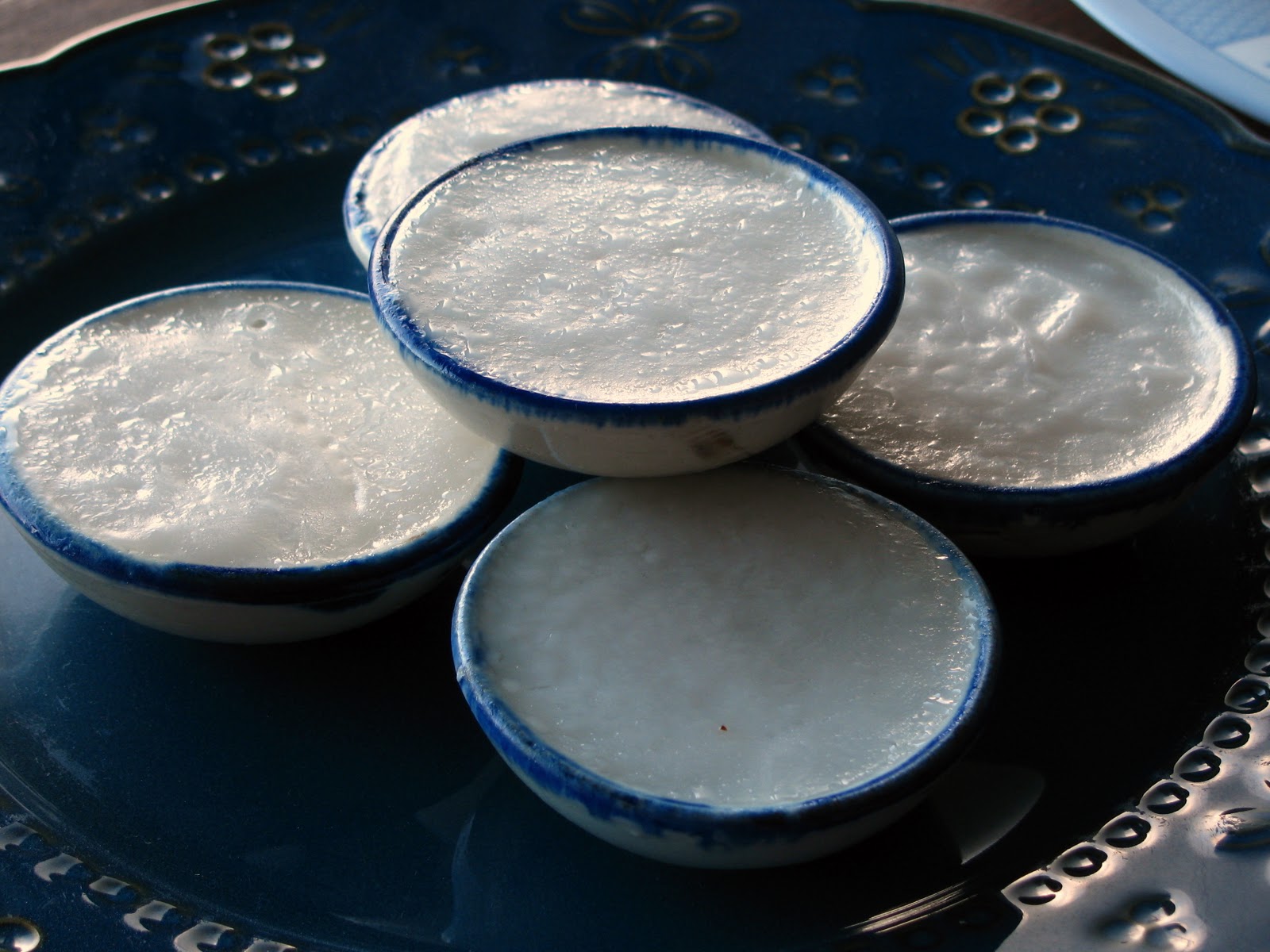
But! It meant that I felt quite celebratory, so I opened up a package of these guys. I am a sucker for anything that comes in its own serving dish. Trader Joe's used to sell some things that came in a terracotta ramekin. They're discontinued, whatever they were, but the ramekins were great. Anyway, Jej and the dinky little blue dishes sold me on these desserts. They're thai, so the label is in french. They say they are Cock brand (snicker snicker) "Frozen Thai Cake" or "Gateau a la Noix de Coco". They do not come with instructions. Jej said "you put them in the steamer" which I did, although I don't know if they are supposed to be as gelatinous as they were when I took them out. They are tremendously sweet, and coconutty, and that's pretty much it. But you do get the cool little stoneware dishes with them. I think their lilliputian dimensions are a great part of their appeal.
I started boiling the pig foot as soon as I got home, and I swiped a chicken carcass out of Pete & Cynthia's freezer, which means I'm pretty well committed to making this crazy recipe which calls for jellied soup stock. That I will get pictures of, I promise.
Wednesday, March 2, 2011
I've been knitting
Since December, or maybe even November, actually. It is a soothing occupation in crappy weather. Knitting takes a lot of time. Lots more time that I realized. My nieces in Michigan did not receive their mittens until last week, I'm sorry to say. Thanks for the photo, H. I packed them up the minute I had finished them up, and realized that I hadn't taken any pictures after the UPS man had already whisked them out of my orbit.
I am still lurking around, though. I can't keep knitting forever- the weather is going to get too warm for it for one thing, and in any case I will run out of both patience and elbow tendons. Knitting in small gauges makes neato lookin things, but is tough in the fine motor department. I made some mittens for me, and now I think I'm probably done for a while.
My mittens don't match. That's what happens when you make something to use up the odds and ends from other stuff.
Saturday, February 5, 2011
Fallen Chocolate Souffle Cake
A number of years ago, someone gave me a subscription to Gourmet Magazine. I got tired of tripping over the stack of mags and finally clipped out the recipes that I thought I'd be likely to use within my lifetime. Now that the magazine is defunct, I sometimes wish I'd kept the whole things, until commonsense kicks in and I realize that way lies the path to an appearance on Hoarders.
Instead, I present to you, this cake. I am happy to say that I have no idea which issue this recipe came from. Oh. Haha- there it is at the bottom of the clipping. February 2004. How serendipitous.
12 oz bittersweet chocolate. I used most of one of those Pound Plus dark chocolate bars from TJ's.
1 1/2 sticks unsalted butter, although I ignored the 'unsalted' part as usual, and used salted.
1 1/2 teaspoons vanilla
1/4 teaspoon salt
3/4 cup sugar- That's 12 tablespoons, which becomes relevant during the instructions.
5 large eggs at room temperature
1/4 cup AP flour
Pre-heat oven to 350. Butter a 9-inch springform pan. The instructions say to line the bottom of the pan with a circle of buttered wax or parchment paper, but I think that's silly. I just dusted the buttered pan with cocoa powder, since the bottom of the pan comes out and makes a perfectly good thing to serve with.
Melt the chocolate & butter in a double boiler over barely simmering water. You could do this in a microwave, but you risk over-heating the chocolate and curdling the batter. I like the double boiler method, because it is a bit slow, but more controlled.
While the chocolate is melting, separate the eggs. Put the whites and the salt into a fairly big mixing bowl and whisk the bejebus out of them until they make soft mounds around the whisk. Add 6 Tablespoons of sugar, whisking between each one to prevent the eggs from deflating. Continue whisking violently until the whites form stiff shiny peaks and there is no separate liquid left in the bowl.
Keep an eye on the chocolate. Stir it a bit every once in a while. As soon as the chocolate is melted, take it off the heat. If you stick your finger in it, it should be pleasantly warm, that way you know it isn't too hot for the eggs.
Whisk the egg yolks, sugar & vanilla together, then drizzle into the chocolate. Then whisk in the flour. Once the chocolate & yolks are combined, give the whites one last beating to take up any liquid that has separated out. Mix about a third of the whites into the chocolate to lighten the texture, then gently fold the chocolate mix into the rest of the egg whites.
The instructions say to bake it for 35 to 45 minutes, but I am suspicious of my oven's functionality. I actually raised the temperature to almost 375, and went for about 40 minutes. Since it is a souffle related thing, I can't keep opening the door to look at it, and I felt little anxious about it. I guess I should get a new bulb for my oven light. Sigh. As you can see, the point of the thing is that it poofs up quite a bit in the oven, then falls down as it cools and forms a macaroon-like crust. Let it cool for a good 10 or 15 minutes before you take the sides of the pan off.
It looks pretty good, but it came out a little dry. 5 minutes less in the oven, I think. The topping definitely is a plus.
Strueberry Glue
a cup each of frozen strawberries & blueberries
1/4 cup sugar
1/2 teaspoon cornstarch
Put the berries & sugar in a little saucepan on medium. As soon as it begins simmering, mix the starch with a teaspoon of water and stir it in. Wait til it thickens, and remove from heat.
I liked a number things about this recipe right off the bat. It uses the entire egg, for one thing. I am not totally against recipes that use uneven quantities of whites & yolks, but I'd rather not have leftover bits and parts in the fridge. Also, it allows you to adjust the degree of sweetness quite a bit. I didn't add quite the full amount of sugar called for. I prefer more chocolate and less sweet, the older I get. The recipe does not call for anything exotic or expensive, which is unusual for a Gourmet Mag recipe, neither does it require an unusual investment of time, technique or bizarre equipment. An electric mixer would be a nice thing to have for the egg whites, but it took me very little time to do it by hand and I got a good upper-body workout at the same time.
Tuesday, February 1, 2011
Plum Buns!
Pardon the not so great pictures. This post is a result of impulse behaviors. The first was buying the steamer at goodwill, the second was deciding yesterday morning that I had to make mantoh rightnow!
I took the first plain white bread recipe I found online:
1 cup water
3 cups flour
3 tablespoons oil
3 tablespoons sugar
1 1/2 teaspoons salt
1 1/2 teaspoons instant yeast
and I put it in the dough cycle on my bread machine before I ran out the door to go to work.
When I got home, I punched all the air out of the dough and kneaded it down some. I wanted to work as many of the large bubbles out of the dough as possible. I divided the dough into 8 pieces, and put about 1 1/2 tablespoons of plum jam in each one. I oiled the steamer trays a bit, set the buns in them, then let them proof for about 20 minutes, which was just enough time to get the water boiling really hard in the reservoir pan. 30 minutes of steaming seems to be the right amount of time.
Some notes for next time:
2. The ones that broke open were the ones I put in the trays with the part of the dough where I had pinched the bun shut facing up. Obviously they needed to be sitting on their seals in order not to explode.
3. I think I made the dough a little too soft. When dad made filled buns they were bao dze. He had some method of pinching them closed that created a little swirly pattern on top like a nut had been screwed into 'em.
4. Possibly, I over-proofed the dough. They might hold their shape better if I made the buns as soon as the dough was ready to use.
5. The plum jam was the same as I used last year for making tang yuan. I almost never want it, but it sure is nice to have in the freezer when I do, because it is an almighty nuisance to make.
6. Lastly, another of the miracles of modern technology: microwave ovens. To overcome the rubbery texture these things acquire after cooling, re-heat them on the defrost setting for about a minute. The low power will help avoid the phenomenon of leathery microwaved bread.
Subscribe to:
Posts (Atom)